Servo motor technology forms the heart of modern manufacturing and automation wherever precise motion control is required, from industry to robotics, medical devices, and aerospace.
The word “servo” originates from the Latin root servus, meaning helper or servant. In engineering, it refers to closed-loop systems that automatically self-correct a system’s position, speed, and acceleration through feedback, operating with exact desired precision.
1.Operating Principle of a Servo Motor: Closed-Loop System
When you energize a standard electric motor, it rotates; when you cut the power, it stops. However, you cannot know the exact angle at which the motor stopped or its instantaneous speed under load. What sets servo systems apart is their continuously self-monitoring feedback mechanism.
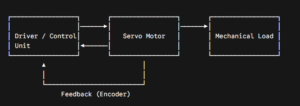
- Issuing the Command: A command such as “rotate the motor 45.5 degrees” or “rotate at 1500 RPM” is sent to the driver.
- Initiating Motion: The driver sends the necessary current to the motor windings to initiate movement.
- Feedback: Sensors integrated into the motor, known as encoders (rotary encoders) or resolvers, transmit the instantaneous position and speed of the motor shaft back to the driver within microseconds.
- Error Correction: The driver compares the targeted position with the current position (Error = Target – Current). It instantaneously adjusts current and voltage until the difference is reduced to zero.
2.Types of Servo Motors
Servo motors are primarily classified based on the type of current they use and their structural design:
a.AC Servo Motors
The most common type used in industrial applications. They feature a brushless design.
- Advantages: High torque, high speed, maintenance-free long service life, and high efficiency.
- Applications: CNC machinery, plastic injection molding machines, packaging lines, industrial robotics.
b.DC Servo Motors
Smaller-scale systems, generally manufactured as brushed or brushless DC motors.
- Advantages: Simpler control mechanisms and lower cost compared to AC systems.
- Applications: Medical equipment, AGVs (Automated Guided Vehicles), small-scale automation projects.
c.Key Advantages of Servo Motors
| Feature | Description |
| High Precision | Delivers micron-level positioning and millisecond-level speed control. |
| Torque Under High Load | Capable of producing maximum torque even at low speeds (Stall Torque). |
| Energy Efficiency | Consumes power only as needed to move or hold the load (eliminates idle power drain). |
| High Dynamism | Features rapid acceleration and deceleration capabilities. |
| Quiet and Smooth Operation | Advanced driver algorithms deliver vibration-free motion. |
d.Application Areas
Today, servo motor technology is at the core of nearly every sector requiring high precision:
- Industrial Robotics: Joint movements of robotic arms are driven entirely by servo motors and precision gearboxes.
- Plastic Injection Molding Machines: Used in electric injection molding machines to achieve high energy savings and precision during injection screw movement, mold clamping, and ejection.
- CNC and Laser Cutting Machines: Controls micron-level movements of the machining head along the X, Y, and Z axes.
- Packaging and Labeling: High-speed, error-free cutting, filling, and labeling operations are performed with servo precision.
- Aerospace and Defense: Flight surface (flap) controls in unmanned aerial vehicles (UAVs), radar positioning systems, and missile guidance mechanisms.
- Medical Devices: Surgical robots, as well as precise patient table positioning in MRI and CT scanners.
Summary
Servo motor technology represents the perfect synergy of power, speed, and precision. Alongside industrial digitalization and the Industry 4.0 transformation, next-generation servo systems—smarter, capable of predictive maintenance, and seamlessly integrated with their drivers—continue to shape the future of automation.